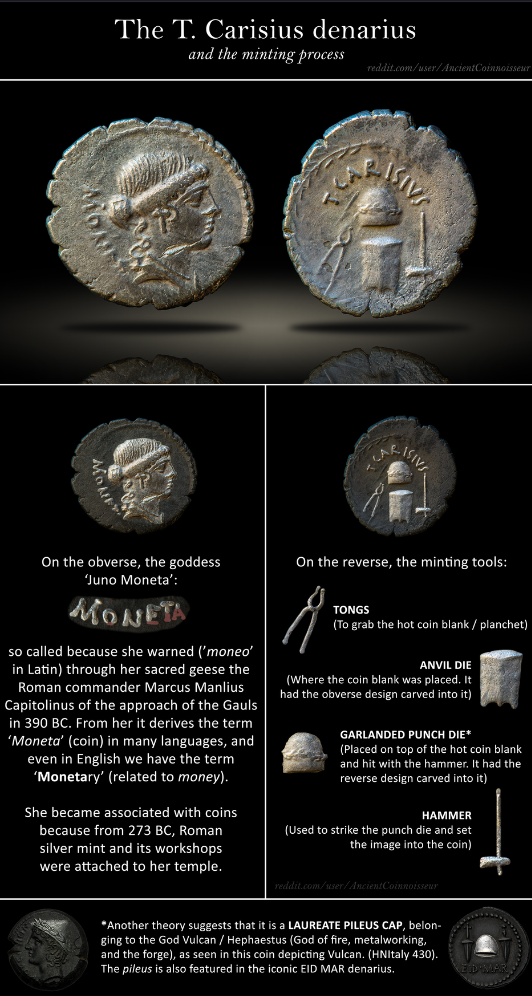
Juno Moneta and the Roman mint
The obverse depicts Juno Moneta. The type refers directly to the office of the moneyer: the obverse alludes to the location of the Roman mint, which stood adjacent to the temple of Juno Moneta. The association between Moneta and the mint also lies behind the later words “money” and “monetary.”
The minting tools on the reverse
The reverse depicts implements used by mint workers to create coins: tongs for handling the heated coin blank or planchet, an anvil die, a garlanded punch die, and a hammer used to strike the design into the coin. This physical act of striking is the direct visual connection to Kopto's name, from the Greek kóptō, “to strike.”
Why the issue was struck
Classical Numismatic Group describes the issue as having been struck to meet the extreme demand for coinage required to pay the veterans of Caesar's quadruple triumph. In that context, the coin's imagery is unusually literal: it identifies the office responsible for producing the currency and shows the tools used to manufacture it.
T. Carisius and the gens Carisia
The gens Carisia was a Roman family known in the latter half of the first century BC. Titus Carisius is traditionally identified with the commander who defeated the Astures in Hispania and captured their chief town, Lancia, around 25 BC. Ancient accounts also record renewed Asturian resistance in 22 BC.
The family is also documented through its coinage. One coin identifies Titus Carisius as triumvir monetalis. Another names Publius Carisius as legate and propraetor and bears the word Emerita, apparently referring to Augusta Emerita in Lusitania, founded by Augustus for veterans of the war in Hispania. On that basis, it has been conjectured that the praenomen Titus assigned to the conqueror of the Astures by Cassius Dio may instead have been Publius.
References
AncientConnoisseur, r/AncientCoins — original infographic and discussion of the T. Carisius denarius and ancient minting process.
Classical Numismatic Group — description of the type, Juno Moneta, the minting implements, and the issue's connection with payments to Caesar's veterans.
Wikipedia — Carisia gens — background on the Carisia family, Titus and Publius Carisius, and the identification question discussed above.